











by Matthew Konkle
Torque Editor-in-Chief
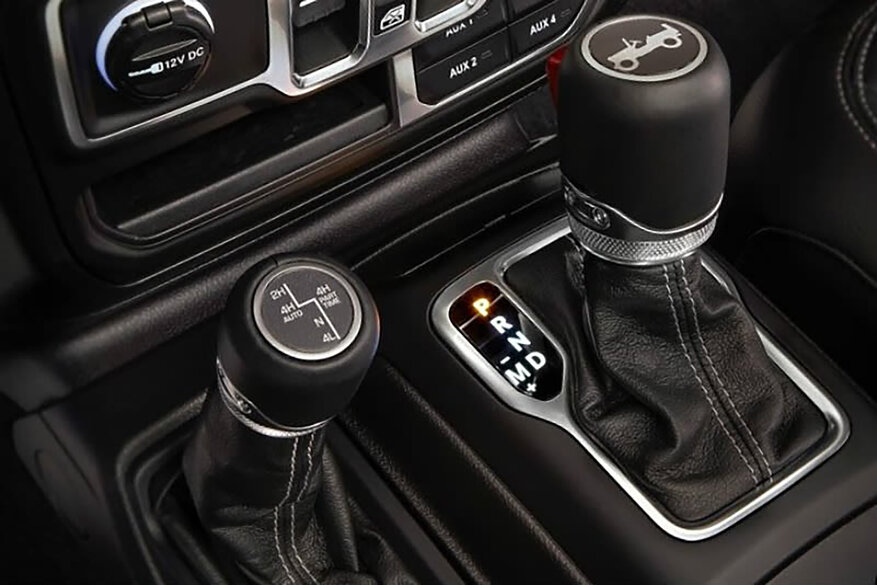
The small, stubby lever just to the left of that gear shifter is often something regarded as a riddle wrapped in a mystery inside an enigma.
That is, a piece often misunderstood at best, or ignored at worst.
It can be a spot where some drape fuzzy air fresheners, or accidentally bang their knees into when reaching over to snatch something from the passenger seat.
A place that often sits untouched by human hands—at least not on purpose—for the life of the Jeep.
Veteran owners know this area as the transfer case shifter. The heartbeat of the vehicle’s ability to securely handle conditions, or terrain, that is a bit more difficult than your standard pavement.
No doubt many others understand this as well. But as realities go, depending on whom you ask and what survey you read, somewhere between 70-90 percent of Jeep owners never take their vehicle off pavement. And thus, most likely never need to use that shift lever.
If that describes you, then no worries. Two-wheel drive works well for the most part on that pavement.
It can be beneficial to know, though, how the thing works. And why.
2H
Called 2-high, this is what is considered the standard gear for all normal rain-or-shine street driving, and will be the position your transfer case shifter sits in for the majority of your driving time—assuming the vehicle is a daily driver. There is nothing extra you need to do to the shift lever when driving in this position.
4H
This position is one spot down on the gate from 2-high, and is normally utilized when you need a little extra traction on dirt roads, hard-packed sand, or slick/snowy/icy roads. You can still operate the vehicle at higher speeds in this position, although you probably want to keep that speed under 50 miles per hour. In this setting, your front wheels and tires help provide the traction needed to overcome these different road conditions.
4L
In 4-low, the Jeep’s front and rear wheels are employed together in low range using a lower gear ratio, all of which results in superior traction at slower speeds, higher torque and better engine braking. This setup is most commonly used when you take your vehicle on more demanding off-road expeditions — when maximum traction and power are needed at those slower speeds — or through things like deeper snow, thick mud, or tricky water crossings. Overall, 4-low helps you better control your vehicle in these challenging off-road conditions when speed is not an issue. In fact, your trail guide, spotter, or friends will normally let you know when you should have this setting engaged.
_____
So, understanding all the different transfer case positions and when to use them is one thing. But understanding how to shift into those settings is another. If you’ve never tried to use the transfer case shift setup, well, it is not quite as simple as pulling down the lever into whatever setting you want depending on the driving conditions.
When you encounter snowy roads, ice, muddy terrain, or sand, it is highly advisable to shift into the 4-high setting by clicking down one spot. This shift can be accomplished while the vehicle is in motion, called ‘shift on the fly’, although many recommend slowing down under 35 miles per hour before moving into 4-high and then keeping the vehicle somewhere between 15-50 miles per hour.
In comparison, moving into 4-low is something you should only attempt when extra traction and control at low speeds is necessary, such as while rock crawling, pulling someone out of a stuck situation, attempting to power through thicker mud, water crossing, or other forms of more intense off-road driving. To reach 4-low, first move into 4-high at a slow speed, then put the gear shift into neutral and pull the transfer case shift lever all the way down into 4-low. While it is sometimes possible to shift into 4-low from a standstill position, it is not recommended as the gear teeth may not line up correctly. Additionally, 4-low should never be engaged during normal pavement driving, as this can cause heat buildup and potentially damage the transfer case. Also, it is best to keep your speed somewhere under 15 miles per hour with this setting. If you can go faster, you can probably move back into 4-high without an issue.
To disengage your four-wheel-drive system, slow your Jeep down to a crawl and shift from drive into neutral. Then, while still rolling forward, push the transfer case shift lever up into 4-high. Once that is accomplished, put the Jeep back into gear and slide the transfer case handle up into 2-high.
Related Jeep Guides, Tips & Trail Advice:
Top Five Jeep Wrangler Alloy Wheels