





by Jerry Horn
Quadratec Channel Correspondent
A trailer hitch is a pretty common part on Jeeps, SUVs and pickup trucks these days. But while many may have a hitch on the back of their vehicle, there are definitely some important details that often are not completely understood—mainly, what type of hitch and can I tow with the thing?
There are many ways of addressing this, but here we are going to work with Class 1, 2, 3 and 4 hitches. We’ll also be using the Society of Automobile Engineers (SAE) standard J684 for our trailer weight limits.
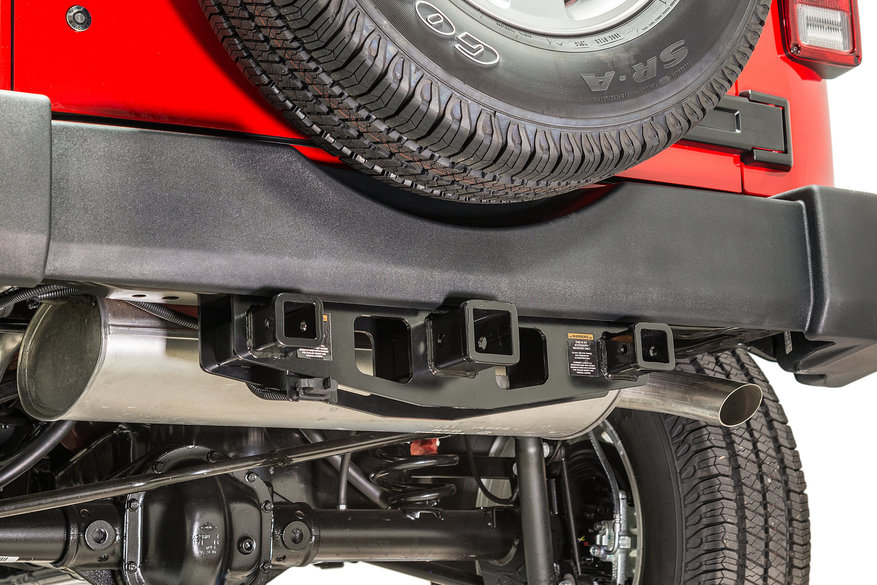
First, a word to the wise. Our Jeeps can be outfitted with a trailer hitch receiver either as separate mount into the frame, or integrated into a bumper. However, just because your bumper may have a hitch on it, does not mean it will accommodate a trailer. See, many bumper/hitch combinations are just not rated for towing, so definitely check the product details before you try hooking up a trailer.
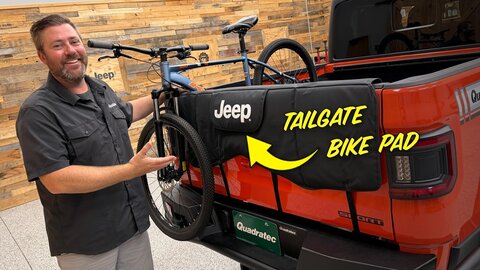
In general, if there are attachments for tow chains in your setup, then the receiver is likely tow rated, but, again, it is always smart to verify what you actually have before towing. Also, how the bumper is actually mounted to the Jeep (crossmember vs direct to frame), as well as bumper materials and overall strength can affect the towing capability as well. One other thing, should your bumper/hitch combination not rise to tow-strength capability, it isn’t useless. It can still be effectively used for other things like attaching a cargo or bicycle rack.
If you do not already know, all hitches are not created equal. Thus, they are assigned separate ‘classes’ depending on their towing capability.
Class 1 hitches are ones not commonly seen on modern Jeeps, and are identified by the 1-¼” x 1-¼” opening in the receiver, and have a maximum 2000 lb tow rating with a maximum 200 lb tongue weight. Normally, this lightweight hitch is best used by those who want to accommodate simple accessories like a bicycle rack. Should someone want to use it for lightweight towing, then a 1-⅞” ball works best with a simple 4-pin wiring harness.
Moving up, Class 2 hitches typically share the same 1-¼” x 1-¼” opening as their Class 1 brother, but are rated to tow 3500 lbs with a 350 lb tongue weight. This increased strength allows use of heavier accessory racks with less worry of breaking on rough roads. For actual towing, a 2” hitch ball is normally best, along with the standard 4-pin wire harness.
Class 3 hitches, on the other hand, come with a larger 2” x 2” opening and can be rated up to 5000 lbs for towing, and 500 lbs of tongue weight. With a weight distribution attachment, manufacturers often specify a higher weight rating, but it is important to remember this will not increase the vehicle’s payload limit. Hitch ball size is also normally 2”, but some trailers may use a larger size.
Class 3 is also the most common rating for Jeep hitches and a variety of accessories are available, such as cargo racks, plugs, locks, steps, tow bars and wiring harnesses. Additionally, trailers attached to this class hitch are normally at the heavier end of the weight range and will have brakes, so they often require a 7-pin trailer harness and brake controller. The 7-pin harness supplies brake signal along with the option of auxiliary power for lights and charging an onboard battery.
Class 4 hitches have the same 2” x 2” opening, but are usually found on larger SUVs and pickups as this class hitch has an increased towing capacity up to 10,000 lbs. In the Jeep world, these Class 4 receivers can be found on some Grand Cherokees as well as the upcoming the Gladiator. All trailers needing a Class 4 hitch will have brakes, so the appropriate 7-pin harness and a brake controller are important options.
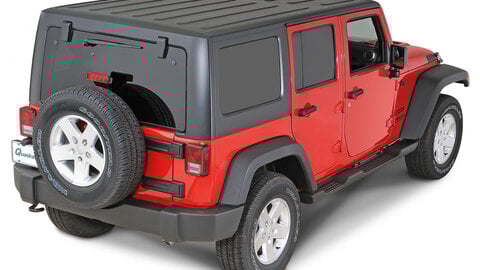
The most common hitches found on CJs and Wranglers normally have a 2” x 2” opening for accessory compatibility, and will be labeled Class 2 or Class 3 depending on the manufacturer. Typically, 2-door Jeeps have an overall 2000 lb maximum tow rating, while 4-door Wranglers bump that number up to 3500 lbs. Check your owner’s manual for your specific configuration. One reminder, just because you install a Class 3 hitch on your vehicle does not mean it automatically changes the vehicle’s tow rating. Your vehicle itself will always determine the maximum tow capacity, not the hitch.