







by Matt Konkle
Quadratec Channel Editor
You know all about the engine in your Jeep generating power when you hit that skinny pedal. The wheels turning to help get you down the road. Then you decide to add larger tires. Plus a lift kit.
And now you have some weird vibration when you accelerate; one that doesn’t seem to go away and sounds like it is getting worse.
If that matches something you have going on right now, then it could be time to address your Jeep’s driveshaft. Even if you are not getting that noise, but you’ve added - or are planning to add – a lift kit, then it makes sense to upgrade that factory driveshaft before you hear a snap or clunk. Before you find yourself stuck on the trail (or road) with a broken one which, let's face it, won't be pleasant for anyone.
Some of you may already know this, but for many, a Jeep driveshaft is a mystery part lying underneath their Jeep. Something often forgotten while sexier things like suspension lifts or larger tires are installed.
So here is some driveshaft information and reasons why you should replace the factory version when you make the call to install a suspension lift, tires, or even horsepower-boosting accessories like superchargers or turbo systems.
Here is what you need to know.
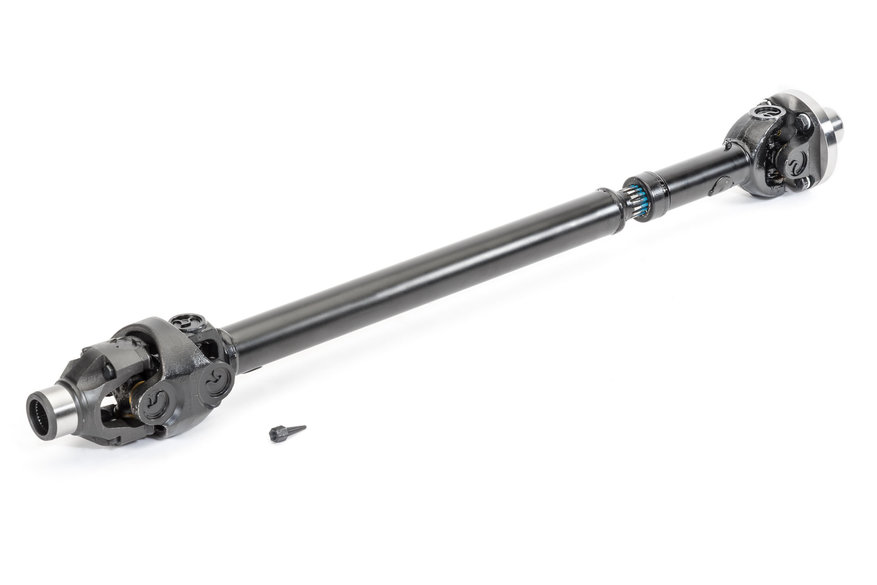
The front and rear driveshafts on your Jeep are essential tools which connect, via universal joints (u-joints), to the transmission and differentials. They are key ‘muscles’ that help provide power from the engine to your vehicle’s wheels, as well as sending torque from the transfer case to the differential.
However, Jeep factory driveshafts are not the toughest of animals and can easily break or wear down faster under the added stress of off-road driving, installation of a lift kit, or addition of larger tires.
Sadly, under the excitement of putting on these new products, upgrading the front and rear driveshaft (or both) often falls by the wayside. As a result, the factory driveshafts often become victim to fatigue from increased articulation when off-road, or the added power needed to turn those bigger tires. How-To: (Rebuilding a Dana 30 Front CV Driveshaft).
A horrible-sounding clunk, your Jeep shuddering upon acceleration or a hard cabin vibration are usually the first signs of a driveshaft problem, as well as it being more difficult to turn the tires. So upgrading the Jeep’s driveshafts should be an essential part of your to-do list while installing a lift kit, larger tires, or even those superchargers or turbo systems.
Generally, you should consider replacing the factory driveshaft when installing any lift kit, but it is highly recommended when adding a 2.5” or higher lift. The reason for this is simple. Lift kits change the suspension geometry and that doesn’t play well with shorter factory driveshafts because of the additional suspension travel. Plus, some who install these kits plan to take their vehicles off-pavement and that extra articulation can break or severely damage weaker factory shafts. Upgraded aftermarket driveshafts have the extra length, and strength, needed to accommodate these changes.
Another reason to upgrade your driveshafts doesn’t have to do with lift kits at all, but engine power. Factory shafts are rated to turn at certain speeds, so when power is increased from things like superchargers or turbo kits, these shafts normally do not handle that extra juice very well. This leads to a lot of wear and tear and eventual failure.
The addition of larger tires is also a big reason to change out those driveshafts. While tires themselves do not change suspension geometry, their heavier weight requires more initial torque to turn. A stronger aftermarket driveshaft has the toughness to put up with that extra needed power.
But even if you have not upgraded to a larger lift kit, or added any power-inducing equipment, you still should at least inspect your factory driveshaft. Especially on higher mileage vehicles. Over time, even under normal road conditions, these shafts take wear and tear from things like road salt and extreme weather, and their rubber casings can tear. Plus, the u-joints can become damaged. Unfortunately, many factory driveshafts have little to no provisions for lubrication, so there isn’t much to be done to prevent them from wearing out.
Now, after you’ve decided to upgrade your factory driveshaft, what is the best direction to go? Well, for JK Wrangler owners, 1310- and 1330-sized u-joint shafts are solid, standard kits, followed by the beefier 1350. YJ and TJ applications utilize a 1310 u-joint size for non-Rubicon models while 1330 is used for Rubicon models. Additionally, for those planning on lifting their Jeep 4” or more, there are CV (constant velocity) driveshaft upgrades available. These also require converting to a slip yoke eliminator kit.
Most owners looking to upgrade their Jeep driveshaft will be best served by ones that utilize either 1310 or 1330 u-joints, as these are more than adequate in an aftermarket shaft for anyone running up to a 37” tire. While some do convert to a 1350 u-joint driveshaft because of the extra strength, this could also be a drawback should that shaft break. This is because most people you'll meet on trail rides utilize a 1310, and will most likely carry replacements for that style, so it will be easier to get yourself fixed up. However, if you plan on more intense rock crawling, and are running larger 40” tires with high-end Dana 60 axles, then the stronger 1350 u-joint shafts are absolutely worthwhile. For more information about u-joints, we’ve put together a handy driveshaft u-joint upgrade guide.
So don't be caught off guard with driveshaft issues either after you've installed that shiny new lift kit along with new tires, or taken the vehicle off-road for a weekend adventure. Make sure you've also upgraded those driveshafts to safely compliment your other additions. Not only will it help your ride quality, but it just may save you hours of trailside—or roadside—frustration.