










by Torque Staff Report
So, just what exactly is a Jeep track bar (sometimes referred to as a panhard rod, panhard bar or track rod), and what is its purpose on my vehicle? If you've ever asked yourself those questions and are still not quite sure, this article will help you understand track bar basics and what the part does for your vehicle.
First, let's cover those basics: A track bar is a vital component of your Jeep's suspension system. Its purpose is to keep track of the relation between the Jeep's body and its axle assemblies. In other words, it is a suspension link that helps keep the axle centered under the Jeep no matter how much your other suspension components articulate or flex.
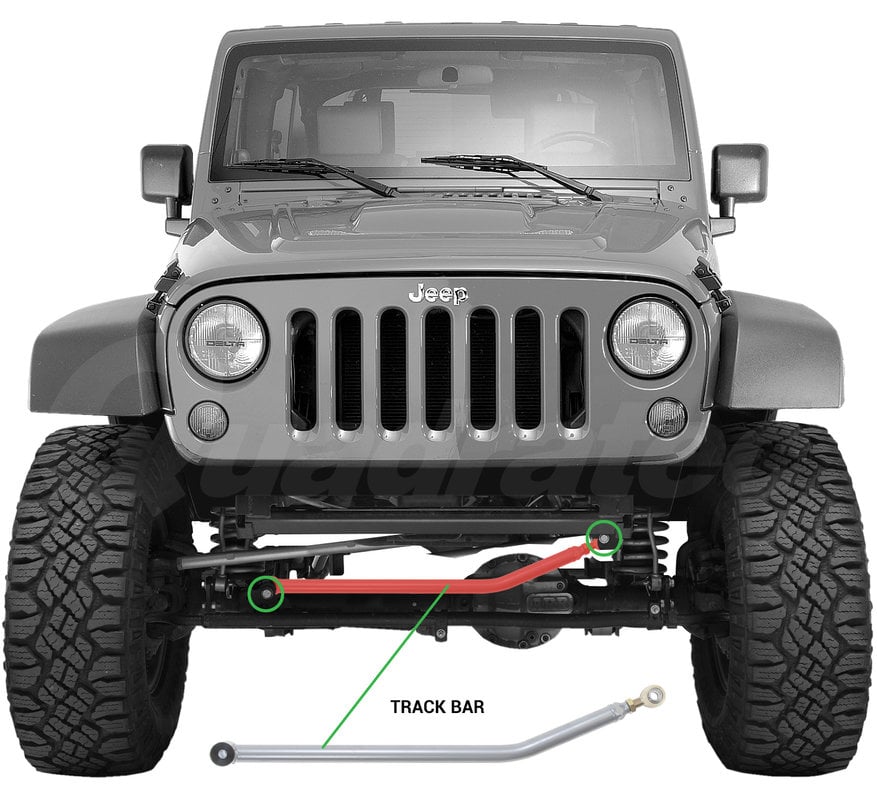
A track bar works by two attachment points - one found on the frame/body and the other on the adjacent side of an axle assembly. Those two attachment points are connected by a link which is the track bar.
Track bars are designed to prevent unwanted lateral movement of your vehicle's axle assemblies. So, if you had no track bar on your Jeep, then you would feel the body float severely left or right over the axles when turning which, most likely, would lead to catastrophe due to the physics of energy and momentum. Beyond just the simple driving aspect, it would also be an extreme failure to traverse any type of off-road terrain without a track bar. They are a necessity and must be properly tuned.

When upgrading your suspension by adding a lift kit, the added height will throw off the alignment of your track bar, shifting it left or right of center (a short track bar will shift the front axle assembly to the driver side - one that's too long will shift your front axle to the passenger side). *See Diagram above (track bar reversed for illustration purposes). In order to adjust that alignment back to center, an adjustable track bar or one with a longer fixed length, will solve the problem. This will also help your Jeep track perfectly while driving, meaning it won't look like it is crab walking down the road sideways.
A worn-out track bar, or one out of adjustment, can lead to extra wear and stress on other suspension components. It can also cause 'bump steer' and even aid the effects of 'steering wobble'. So it is very important to keep it adjusted properly - especially when installing a lift kit greater than 2.5 inches.
There are many different types of track bars on the market, such as factory, tapered ball-joint-style end or double shear style ends. Even fixed length or adjustable length track bars depending on your suspension goals/needs. A general rule-of-thumb is if you're not planning on a lift kit greater than 2.5", then the factory-style track bar is fine. However, if you are installing a lift 3" or taller, then you should definitely look into a longer, more heavy-duty track bar. Preferably an adjustable length one with double shear style end links and accommodating frame brace for smoother suspension travel and elimination of 'bump steer'. Bump steer is when you hit a bump in the road and feel your steering wheel twist left or right. This normally means the geometry of your suspension components is nearly maxed out, not allowing it to easily overcome those bumps in the road.

No matter which style track bar you choose, remember this; a tuned suspension is a happy suspension. Keep your track bar properly adjusted.
Check out our extensive track bar selection, as well as other suspension parts, on our Lift Kit and Suspension Page.